Home › Videos › The Federal Reserve Case, Episode 1
The Federal Reserve Case · Episode 1
Who Really Controls the Federal Reserve? Congress Can Shut It Down — and Never Has
Video · 17 min · Published October 20, 2026 · 24 sources
Congress can end the Federal Reserve with a single law. The president can remove a Fed governor only “for cause” — and in 2026 the Supreme Court kept Lisa Cook in office. Private banks pick six of nine directors at each Reserve Bank. And since 2007, not one bill to abolish the Fed has reached a vote.
The Federal Reserve was created by an act of Congress, and Congress can abolish it the same way — with a single law. In the 113 years since 1913, it never has. A president, meanwhile, could not remove even one member of the Fed's Board.
The timing is not abstract. On October 27–28, 2026, the Fed makes its last interest-rate decision before the midterms; the next meeting is not until December.24 It will be announced by Chair Kevin Warsh, who took the oath on May 22.23 Six days after that decision, on November 3, Americans elect the very Congress that could shut the Fed down. We built this case from seven documents: laws, court rulings and the Fed's own reports.
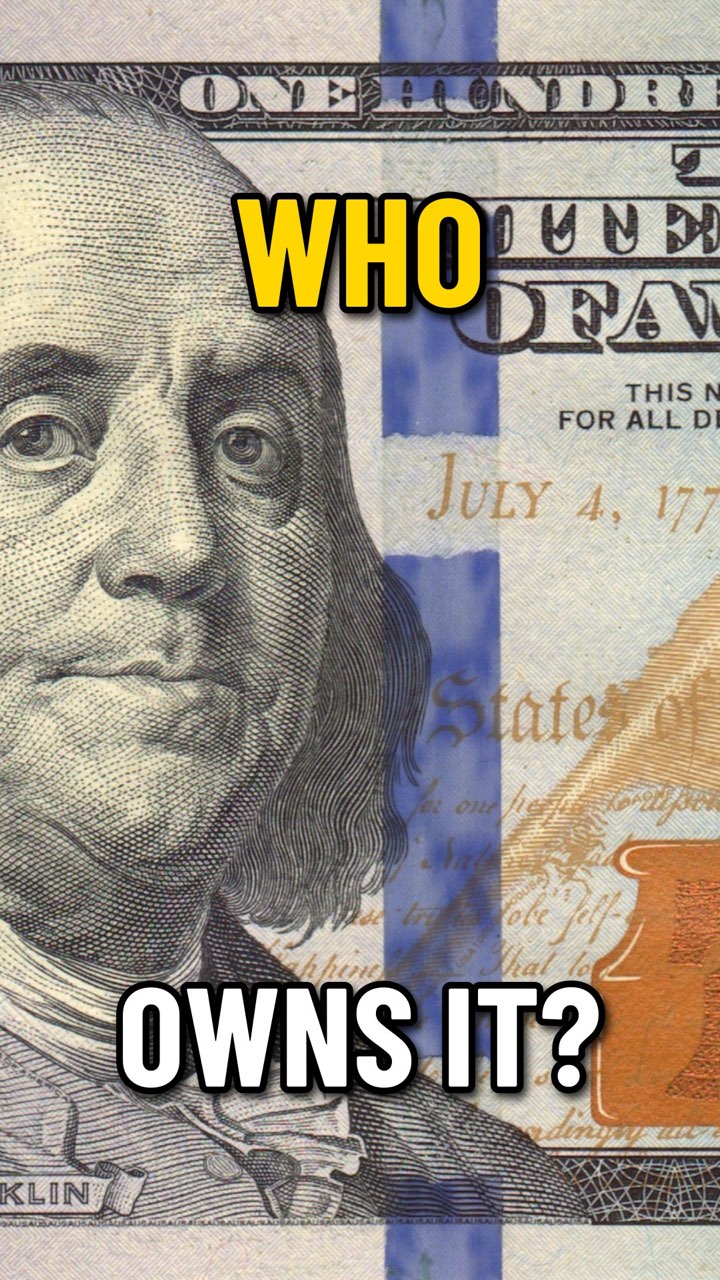
Every bill in your wallet says “Federal Reserve Note” across the top — not Congress, not the Treasury. It is tempting to conclude that the money belongs to the Fed. The oldest document in the case says otherwise: Article I, Section 8 of the Constitution gives the power “to coin Money, regulate the Value thereof” to Congress. Not the president, not a bank.1
Is the Fed, then, simply an arm of Congress? In May 2025 the Supreme Court described the Federal Reserve as “a uniquely structured, quasi-private entity.” It was only an order in a case about another agency, but the Court chose the words itself.3 On paper, Congress controls the money; in practice, it is run by an organization the Supreme Court calls almost private.
The popular answer online is yes: the Fed is a private bank that owns the dollars, prints them for itself and keeps the profit. As proof, people quote Woodrow Wilson, the president who signed the Federal Reserve Act on December 23, 1913:4 “I have unwittingly ruined my country.” The quote appears in none of Wilson's speeches or letters; journalists who checked it concluded it was stitched together from unrelated passages.5 The real Wilson is in this story too — on the $100,000 gold certificate, a note used only between Federal Reserve Banks.6
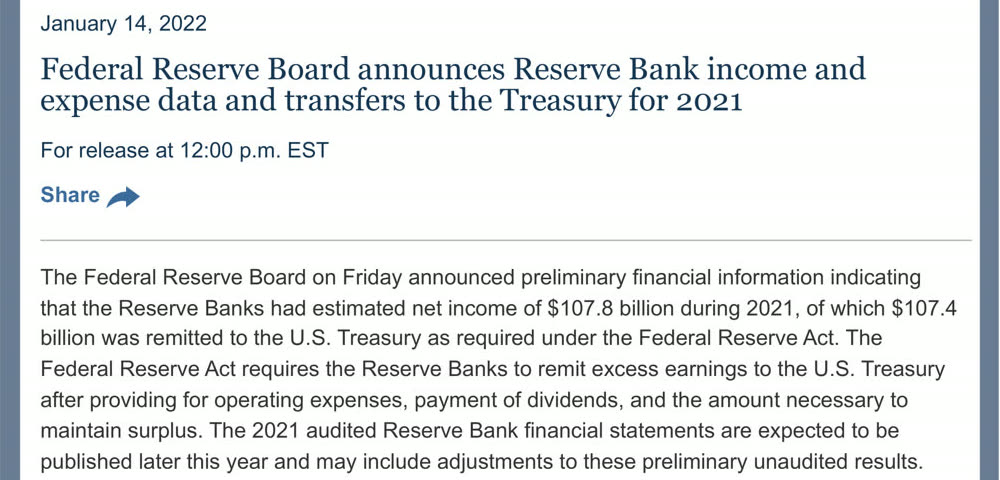
The myth has a grain of truth: the twelve Reserve Banks really do have stockholders, and they are private banks. But owning a share is not owning the dollar. Two tests show the difference. First, profit: a private bank keeps it, while the Fed hands it to the Treasury — $107.4 billion for 2021 alone.7
Federal Reserve Board press release, January 14, 2022: of $107.8 billion in estimated net income, $107.4 billion went to the Treasury. Source: federalreserve.gov.7
Second, control: nobody confirms the owner of a private bank, but the Senate confirms the chair of the Fed. Kevin Warsh was confirmed in May 2026 by 54 to 45 — according to The Wall Street Journal, the narrowest margin for any Fed chair.8 Even the gold in the vault beneath Manhattan, the New York Fed says, does not belong to it.9
Exhibit 1: “We did it” — the Fed and the Great Depression 4:38
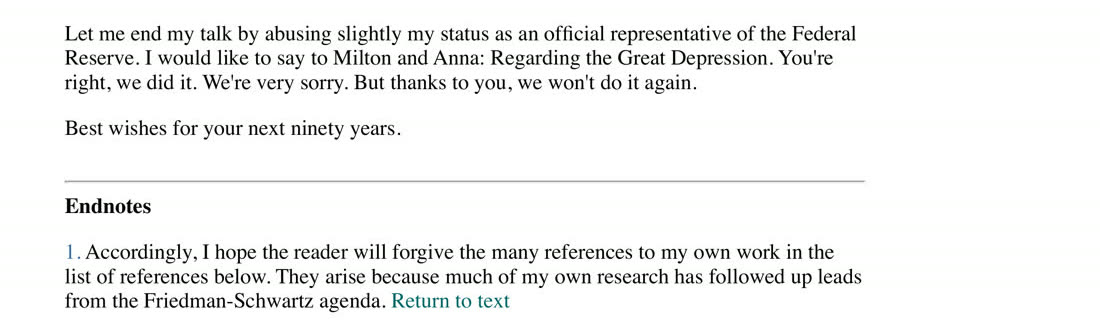
If the Fed is part of the government, who answers when it gets things wrong? On November 8, 2002, Fed Governor Ben Bernanke — three months on the Board — spoke at the University of Chicago at a conference honoring Milton Friedman's 90th birthday. He ended by turning to Friedman and his co-author Anna Schwartz:
“I would like to say to Milton and Anna: Regarding the Great Depression. You're right, we did it. We're very sorry. But thanks to you, we won't do it again.”10
Remarks by Governor Ben S. Bernanke, November 8, 2002. Source: federalreserve.gov.10
Friedman and Schwartz had shown that from August 1929 to March 1933 the money supply shrank by more than a third — and the Fed let it happen.11 It was one governor speaking, not an official ruling. But in June 2005 Bernanke left the Board, and seven months later he was back as chair, serving from February 1, 2006, to January 31, 2014.12 An institution can make a mistake that large, keep its power — and the man who admitted it gets the top job.
The Federal Reserve Act uses a phrase that does not sound like a government agency: “stockholding banks.” The system is a Board of Governors in Washington plus twelve regional Reserve Banks, and the stockholders of each Reserve Bank are private member banks.2
Each Reserve Bank has nine directors in three classes of three. Class A directors are chosen by the stockholding banks and represent them. Class B directors are supposed to represent the public, but they are elected by the same member banks in the same way. Only Class C directors are appointed by the Board. Six of nine seats — two-thirds — are picked by member banks.2 Since 2010, under Dodd-Frank, a Reserve Bank's president is chosen by the Class B and C directors with the Board's approval; the bankers' Class A directors no longer vote.2
The Board itself works differently: the president nominates its members, the Senate confirms them, and the term is fourteen years.18 Until 1935 the Board was chaired by the Secretary of the Treasury. The Banking Act of 1935 removed him, and since February 1936 no Treasury Secretary has sat on the Board — Congress's decision, not the banks' or the president's.13
At a House Financial Services hearing in July 2026, Rep. Maxine Waters read Chair Warsh Section 10 of the Act: no member of the Board “shall be an officer or director of any bank … or hold stock in any bank.” Warsh answered: “It's the law you've written and it's the law we will follow.”14
Exhibit 3: The 2008 loans the banks kept secret 9:03
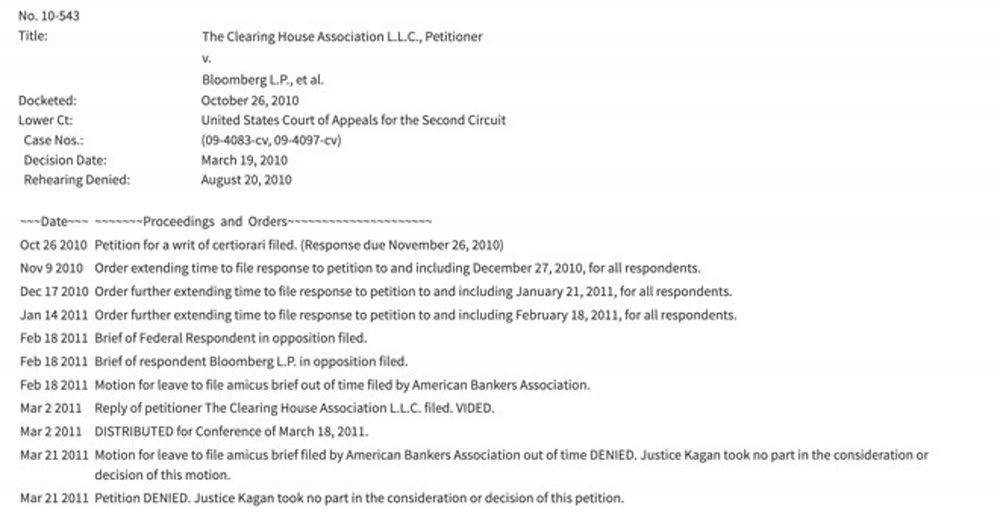
During the 2008 crisis, Bloomberg asked the Fed under the Freedom of Information Act to name everyone who borrowed through its discount window — who, how much and when. The Fed refused, and Bloomberg sued. On March 19, 2010, the Second Circuit sided with Bloomberg.15
Then the banks stepped in. Their association, The Clearing House, petitioned the Supreme Court to keep the names secret. The case name tells the story: not Bloomberg v. the Fed, but the bankers' association v. Bloomberg. On March 21, 2011, the Supreme Court refused to hear the petition.16
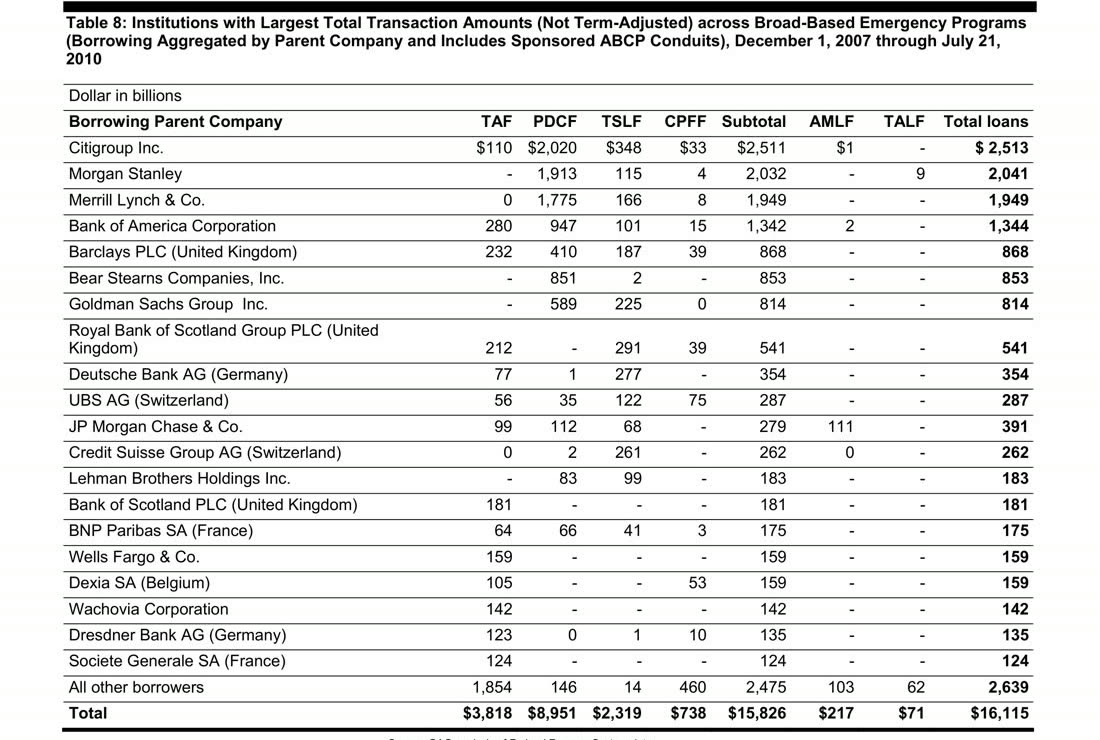
Ten days later the Fed published the names, amounts and dates — and its own notice said why: the Supreme Court had declined to review rulings in two lawsuits brought by media companies.17 Earlier, on December 1, 2010, the Fed had released data on its emergency programs, also not by choice but because Dodd-Frank required it. The same law ordered a one-time audit by the GAO, which arrived at one number: $16.115 trillion — every loan from December 2007 to July 2010, with each rollover counted again.19
GAO-11-696, Table 8 (p. 131): total transaction amounts, not term-adjusted — $16,115 billion. Source: gao.gov.19
A Fed governor serves fourteen years, and the president may remove one early only “for cause.” The law does not define cause.18 Presidents have pushed before. In late January 1951, Harry Truman invited the entire Federal Open Market Committee to the White House; afterward the White House announced the committee had pledged its support to keep bond prices stable. The committee had made no such pledge, and Marriner Eccles released the committee's own account of the meeting.20 In December 1965 Chair William McChesney Martin persuaded the Board to raise the discount rate from 4 to 4½ percent, effective December 6,28 over Lyndon Johnson's objections. Johnson summoned him to his Texas ranch; Martin held his ground.21
In 2026, President Trump tried to fire Governor Lisa Cook, citing an “infraction” he first raised in August 2025.23 On June 29, 2026, the Supreme Court ruled 5 to 4 against the government: Cook stays in office while the fight continues. The Court decided on narrow grounds — she had not been given the process the law requires, notice and a hearing — and did not weigh the cause itself. The same day, voting 6 to 3 in another case, the Court overturned an old precedent that protected the heads of independent agencies from removal, while noting the Fed may be a special case, heir to the First and Second Banks of the United States. Chief Justice John Roberts was in the majority both times and wrote the second opinion.22
The White House then set up a three-member committee — Hassett, Lucas and Sonderling — to decide whether there is cause. A closed hearing is scheduled for November 5, two days after the election; Cook's statement is due by November 10, and the findings go to the president. Her lawyers say there is no legal basis to remove her, and the case before Judge Jia Cobb in district court remains open.25
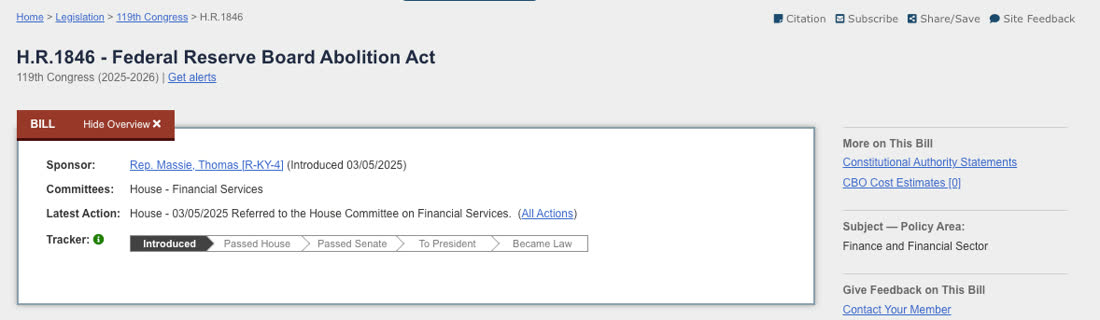
Congress has full power: the Fed was created by a law, and another law can end it. Bills to do exactly that keep coming. In 2007 and 2009 they were filed and sent to committee. The 2011 bill went furthest — to a subcommittee hearing on May 8, 2012, “Improving the Federal Reserve System: Examining Legislation to Reform the Fed and Other Alternatives.” Rep. Ron Paul opened it, saying the hearing would examine proposals “both to mend and to end the Fed.”26 A 2024 bill drew 23 co-sponsors and went to committee. In 2025 the Federal Reserve Board Abolition Act, H.R. 1846, was filed on March 5 and sent to the Financial Services Committee the same day, with eleven co-sponsors and no further action; a matching Senate bill went to the Banking Committee and stayed there.27
H.R. 1846 (119th Congress) on congress.gov: introduced and referred, no further steps. Source: congress.gov.27
Since 2007, not one of these bills has reached a floor vote in the House or the Senate. Ron Paul filed the first three; Thomas Massie filed the last two in the House, and Mike Lee in the Senate. Massie says Paul first filed one in 1999 — we could not confirm that, so we count from 2007.
Where Episode 1 leaves us: the president is boxed in — he can remove a governor only for cause and only with due process. Congress can shut the Fed down with a single law and has never brought one to a vote. Your money is run by an organization the president cannot remove — and Congress can, but won't. Why? That is Episode 2.
Committee of inquiry on Gov. Lisa Cook (Federal Register, Oct 14, 2026) — SCOTUSblog
“Improving the Federal Reserve System: Examining Legislation to Reform the Fed and Other Alternatives,” House Financial Services Subcommittee on Domestic Monetary Policy and Technology, May 8, 2012 (Serial No. 112-121) — govinfo.gov; Rep. Ron Paul, opening statement — financialservices.house.gov
H.R. 2755 (110th), H.R. 833 (111th), H.R. 1094 (112th), H.R. 8421 (118th), H.R. 1846 and S. 869 (119th) — congress.gov
Archive footage in the video: Board of Governors of the Federal Reserve System, Library of Congress (Carol M. Highsmith), Architect of the Capitol, National Archives, Universal Newsreel. Narration voice is AI-generated. Educational and commentary use (17 U.S.C. § 107). Not financial advice.
Full transcript
0:00 · Who Really Controls the Fed?
Congress can shut down the Federal Reserve with a single law. In a hundred and thirteen years, it hasn't. The president couldn't fire even one member of its Board. So who really controls your money — and why can't anyone stop them? We've built a case from seven documents. One of them, the Fed refused to show — until a court forced it to. On October twenty-seventh and twenty-eighth, the Fed makes its last interest-rate decision before the midterms.
The next one isn't until December. Chair Kevin Warsh will announce it. On May twenty-second, he took the oath.
Justice Thomas: And that I will well and faithfully discharge the duties of the office on which I am about to enter.
Kevin Warsh: …the duties on the office upon which I'm about to enter.
Justice Thomas: So help me God.
Kevin Warsh: So help me God. Six days after that decision, on November third, America elects the very Congress that could shut the Fed down.
Seven documents: laws, court rulings, the Fed's own reports. Every one is on screen and linked in the description. So whose money is it, really? Let's open the first one.
1:26 · Whose Money Is It? Congress vs the Fed
Pull any bill out of your wallet.
Across the top it says: Federal Reserve Note. Not Congress. Not the Treasury. The Federal Reserve.
The obvious conclusion: if the Fed's name is on the money, it's the Fed's money. But the oldest document in this case says otherwise. The Constitution of the United States, Article One, Section Eight. The power "to coin Money, regulate the Value thereof" goes to Congress. Not the president. Not a bank. Congress.
Then try version two: the Fed is just an arm of Congress. One document settles that. May, twenty twenty-five. The Supreme Court writes that the Federal Reserve is "a uniquely structured, quasi-private entity." Quasi-private. Almost private. It was only an order in a case about another agency — but the Court chose the words "quasi-private" itself. So here's step one. On paper, Congress controls your money. In practice, it's an organization the Supreme Court calls almost private.
Almost private — so whose is it? The internet has a simple answer.
2:34 · Is the Fed a Private Bank?
The answer goes like this: the Fed is a private bank. It owns the dollars, prints them for itself and keeps the profit. And for proof, people quote the president who signed the Fed into law,
Woodrow Wilson: "I have unwittingly ruined my country." Great quote. It's been circling the internet for years — always without a source. Because there isn't one. It's in none of Wilson's speeches, none of his letters. Journalists who checked it concluded it was stitched together after the fact from unrelated passages. Wilson signed the Federal Reserve Act on December twenty-third, nineteen thirteen. But the real Wilson is in this case — on a one-hundred-thousand-dollar bill that only the Reserve Banks used, between themselves.
In the fake quote, he repents. On the real bill, he's the face of money that never left the system. And the myth does have a grain of truth — we'll need it later. The Reserve Banks really do have stockholders, and they're private banks. But owning a share isn't the same as owning the dollar. Two documents will test it. Test one: profit. A private bank keeps its profit. The Fed hands it to the Treasury. For twenty twenty-one alone — one hundred seven point four billion dollars.
Test two: who's in charge. Nobody confirms the owner of a private bank. The Senate confirms the chair of the Fed. Kevin Warsh was confirmed this May, fifty-four to forty-five. According to The Wall Street Journal, no Fed chair has ever been confirmed by a margin that narrow. Even the gold in the vault under Manhattan, the New York Fed itself says, doesn't belong to it. Step two. "Private bankers" doesn't hold up: your money is run by an organization that hands its profit to the government and whose chair the Senate confirms.
But if it's part of the government — who answers when it gets things wrong? In two thousand two, a man from inside the Fed answered that, out loud.
4:38 · Exhibit 1: "We Did It"
November eighth, two thousand two. Fed Governor Ben Bernanke — just three months on the Board — takes the stage at the University of Chicago, at a conference honoring Milton Friedman's ninetieth birthday. At the end of his speech, he turns to Friedman and his co-author, Anna Schwartz. "I would like to say to Milton and Anna: Regarding the Great Depression. You're right, we did it. We're very sorry. But thanks to you, we won't do it again."
Friedman and Schwartz had shown that from August nineteen twenty-nine to March nineteen thirty-three, the money supply shrank by more than a third — and the Fed let it happen. Bernanke told them, "You're right." That's one governor speaking, not an official Fed ruling. Now the twist. In June two thousand five, Bernanke left the Fed's Board. Seven months later, he was back — as chair. He ran the Fed from February first, two thousand six, to January thirty-first, two thousand fourteen.
Picture any other organization. One of its people stands up in public and agrees: yes, the crash of the early thirties was our fault. Three years later, that same man is running the place. How is that even possible? It changes our answer. Your money is run by an institution that can make a mistake that big and keep its power — and the man who admitted it gets the top job. To understand how, we need to know who the Fed answers to.
And who picks its leaders?
6:12 · Exhibit 2: Who Owns the Fed's Banks?
The Federal Reserve Act contains a phrase that doesn't sound like a government agency at all. "Stockholding banks." The Federal Reserve is a Board of Governors in Washington and twelve regional
Reserve Banks: New York, Boston, San Francisco and the rest. The stockholders of each Reserve Bank are private member banks.
The obvious version: the stockholders are a formality, and Washington calls the shots. Let's check the same law. Each Reserve Bank has a board of nine directors, in three classes of three. Class A directors are chosen by the stockholding banks — and represent them. Class B directors are supposed to represent the public. But they're elected by the same member banks, in the same way. Class C directors are appointed by the Board in Washington.
Do the math. Of nine directors, six are picked by member banks. Two-thirds of the seats. And who picks the president of a Reserve Bank? Since twenty ten, under Dodd-Frank, it's the Class B and Class C directors, with the Board's approval. The bankers' Class A directors no longer get a vote. So in twenty ten, Congress saw the problem and nudged the banks back. But only one step. Class B directors are still elected by the banks.
The Board in Washington works differently. The president nominates its members, the Senate confirms them, and the term is fourteen years. And here's a detail few people know. Until nineteen thirty-five, the Fed's Board was chaired by the Secretary of the Treasury — a member of the administration the president could appoint and remove. With the Banking Act of nineteen thirty-five, Congress itself took him off the Board. Since February nineteen thirty-six, the Treasury Secretary hasn't sat there. Congress's decision.
Not the banks'. Not the president's. July of this year. A House Financial Services hearing. Congresswoman Maxine Waters reads the Fed's chair a line from the Federal Reserve Act.
Rep. Maxine Waters: Section 10 of the Federal Reserve Act states, and I quote, "No member of the Board of Governors of the Federal Reserve System shall be an officer or director of any bank, banking institution, trust company, or Federal Reserve Bank, or hold stock in any bank, banking institution, or trust company."
Kevin Warsh: Excuse me, ranking member. It's the law you've written and it's the law we will follow. Step three. Washington doesn't run everything. Your money is run by a Board the president appoints, and twelve banks where private banks pick two-thirds of the directors. And Congress itself moved the Treasury Secretary away from the table. So when the banks themselves need money — who's borrowing from the Fed? In the crisis of two thousand eight, one news agency set out to find out.
9:03 · Exhibit 3: The 2008 Loans the Banks Kept Secret
If this case has you hooked, subscribe to American Money History. It only gets stranger from here. The Fed wouldn't give up the names. So Bloomberg went to court. Under the Freedom of Information Act, Bloomberg asked the Fed to name everyone who borrowed through its discount window during the crisis. Who borrowed, how much, and when. The Fed refused. Bloomberg sued. On March nineteenth, twenty ten, the Second Circuit Court of Appeals sided with Bloomberg. But it didn't end there.
Now the banks themselves stepped in. Their association, the Clearing House, petitioned the Supreme Court: keep the names secret. Two case numbers, one ruling: disclose the data. Look at the name of the case. Not "Bloomberg versus the Fed." The bankers' association versus Bloomberg. The ones defending the secret were the banks. On March twenty-first, twenty eleven, the Supreme Court refused to hear the banks' petition. The end of the road.
Ten days later, the Fed published the names, the amounts and the dates. And in its own notice, it said why: the Supreme Court had declined to review rulings in two lawsuits brought by media companies. The names of the Fed's discount-window borrowers came out only by court order — after the Supreme Court turned the banks down. The Fed had released data on its emergency programs earlier, on December first, twenty ten — also not on its own, but because Dodd-Frank required it. The same law ordered a one-time audit by Congress's watchdog, the G-A-O. It came back with one number: sixteen trillion, one hundred fifteen billion dollars.
Not all at once — that's every loan from December two thousand seven to July twenty ten, with each rollover counted again. Step four. When the banks need money, the Fed decides on its own — and the country learns the details by law, by court order and from the press. Never because the Fed chose to tell. A court made the Fed name names. But who can make it answer for its decisions?
11:16 · Exhibit 7: Trump vs the Fed and Lisa Cook
A Fed governor gets fourteen years. The president can remove one early only "for cause." What counts as cause, the law doesn't say. Presidents have pushed before. Late January, nineteen fifty-one. President Harry Truman invites the entire Federal Open Market Committee to the White House. All of it. After the meeting, the White House announces that the committee has pledged its support to the president — to keep government bond prices stable for as long as the emergency lasts.
Except the committee had made no such pledge. So a man from inside the Fed, Marriner Eccles, without consulting the committee, released the committee's own account of that meeting. The president's word against the Fed's record. December, nineteen sixty-five. The Fed's Board votes four to three to raise the discount rate from four to four and a half percent. Two days later, at President Lyndon Johnson's ranch in Texas, there's a showdown with Fed Chair Martin.
Martin holds his ground. Twenty twenty-six. President Trump tries to fire Fed Governor Lisa Cook. He gave his reason back in August twenty twenty-five.
Donald Trump: She seems to have had an infraction, and she can't have an infraction, especially that infraction, because she's in charge of, if you think about it, mortgages, and we need people that are 100% above board, and it doesn't seem like she was. Then in May this year, at the new chair's swearing-in, he said this.
Donald Trump: I want Kevin to be totally independent. I want him to be independent and just do a great job. Don't look at me, don't look at anybody. Just do your own thing and do a great job. Okay? On June twenty-ninth, the Supreme Court rules five to four against the government. Cook stays in office while the fight goes on. And what did the president say about the courts?
Donald Trump: I abide by the court. Yeah, I abide by the court. The Court decided on narrow grounds: the president didn't give her the process the law requires — notice and a hearing. The Court didn't weigh the cause or Cook's rights — only the process. The same day, in another case, the Court voted six to three to overturn an old precedent that protected the heads of independent agencies from being fired. But it carved out a caveat for the Fed: it may be a special case, heir to the First and Second Banks of the United States.
Chief Justice John Roberts was in the majority both times — and wrote the second opinion himself. So on a single day, the same Court said: independent agencies have no protection anymore. Except, maybe, one. Then the White House set up a three-member committee to decide whether there's "cause." A closed hearing is scheduled at the White House for November fifth — two days after the election. Cook's statement is due by November tenth; then the findings go to the president.
The committee: Hassett, Lucas and Sonderling. Cook's lawyers say there's no legal basis to remove her. The case in district court, before Judge Jia Cobb, is still open. The president can't fire her — at least not yet. What about Congress? Congress has full power. The Fed was created by a law, and another law can end it. Bills to do exactly that keep coming. Two thousand seven — filed, sent to committee. Two thousand nine — sent to committee.
Twenty eleven — the furthest any got: a subcommittee hearing on May eighth, twenty twelve. It was called "The Fed: Mend It or End It?" Ron Paul opened it.
Rep. Ron Paul: The Federal Reserve has been around for almost 100 years, 100 years next year. And that was it. Twenty twenty-four — twenty-three co-sponsors, sent to committee. Twenty twenty-five — the Federal Reserve Board Abolition Act, H.R. eighteen forty-six, filed March fifth and sent to the Financial Services Committee the same day. Eleven co-sponsors. No further action. The same day, a matching bill was filed in the Senate and sent to the Banking Committee. That's where it stayed.
Since two thousand seven, not one of these bills has reached a vote in the House or the Senate. The authors repeat, too. Congressman Ron Paul filed the first three. Congressman Thomas Massie filed the last two, and Senator Mike Lee filed in the Senate. Massie says Paul first filed one back in nineteen ninety-nine — we couldn't confirm that, so we count from two thousand seven. Where part one leaves us.
The president is boxed in: he can remove a governor only for cause, and only with due process. Congress can shut the Fed down with a single law. And since two thousand seven, it has never brought one to a vote. So here's the answer to where we started: your money is run by an organization the president can't remove — and Congress can, but won't.
16:17 · Why Won't Congress End the Fed?
Congress can shut down the Fed with a single law. In a hundred and thirteen years, it hasn't. Why? Find out in part two of our investigation. Subscribe so you don't miss it. Why do you think Congress keeps its hands off the Fed? Tell us in the comments. We'd really appreciate it if you showed our work some love with a like — it's the best reward for our team. And don't forget to subscribe to American Money History and share this film with your friends and family, so you don't miss the next episodes of our investigations.
 American Money History